


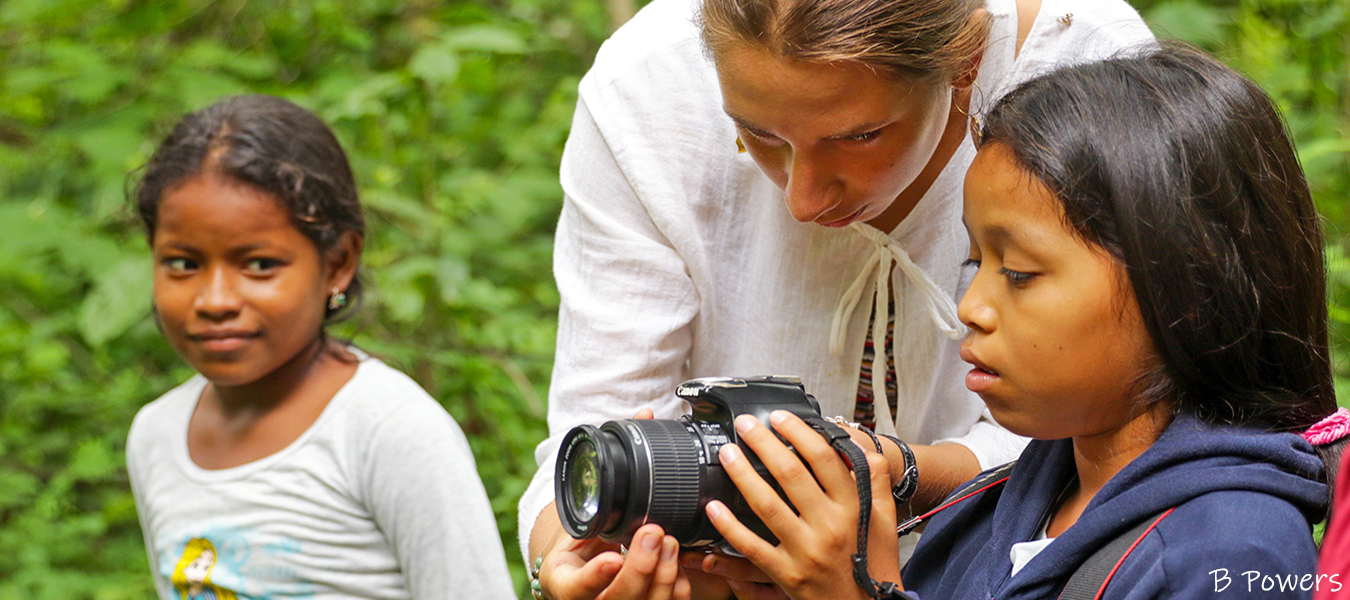
The Ceiba Foundation offers a variety of internships year-round in conservation, research, education, and community development. These internships are a great way to combine your academic background with hands-on field experience. Broaden your horizons and gain valuable experience as you lend a hand to the Ceiba Foundation for Tropical Conservation. As a Ceiba Intern, you will put your knowledge and skills to work for habitat conservation, reforestation, environmental education, community development, and scientific research.
The Manabí coast is lined with white sand beaches and diverse forests
Coastal Ecuador is a beautiful region of verdant hills, quaint villages, and expansive coastline. Your internship in coastal Ecuador will be based at the Lalo Loor Dry Forest Reserve and the nearby communities of Tabuga, Camarones, and Jama, where the Ceiba Foundation has been working since 2004 on conservation, education, and community development projects.
You will be working closely with the Education Coordinator who oversees ongoing projects at the reserve, including internships. The reserve is also staffed by a manager, park ranger and a cook. The nearby community of Tabuga, a 10 minute walk away has a population of approximately 750 people that dedicate themselves to agriculture, tourism, and other small enterprises. Camarones, a 50-minute walk, is located more inland and has a population of about 500 people, most of whom are farmers. Jama is a larger town about 20 minutes south by bus, where there are shops, several high schools, and a hospital.
You'll live and work in the Lalo Loor Dry Forest Reserve, one of the finest examples of coastal dry forest in Ecuador
Interns are housed alongside researchers and volunteers in the wooden station house at the Lalo Loor Dry Forest Reserve that accommodates up to 30 people in four-person rooms adjoining a spacious common area. The station is located within the forest, where howler monkeys wake you nearly every morning. Meals are provided at the station, which has no electricity (but plenty of candlelight!), cold water showers, and composting toilets. At the reserve’s entrance is an educational EcoCenter for visiting tourists and school groups; electricity is available there for charging of cameras, laptops, etc in addition to internet. The rates for our 4-week, 8-week, and 10-week internships cover meals and lodging as well as the training and equipment necessary to complete your research project. Internship sessions take place year round, starting in early January and running through the beginning of December.
Be aware that life in the tropics can be very humid, so interns should plan accordingly. Bring fabrics that dry quickly and leave behind items that are particularly susceptible to mold. There is a dry box available for interns to use for electronics in the EcoCenter.
María José Rendón, Education Programs Coordinator
Majo studied Ecology and Management of Natural Resources at Universidad San Francisco de Quito in Ecuador, and earned a master’s degree in Environmental Sciences from the University of Sydney. She worked as the Director’s Assistant at the Tiputini Biodiversity Station, where she helped co-manage the station, and she has been working with Ceiba for nearly five years.
Domenica Gutierrez, Projects Coordinator
Domenica Gutierrez holds a degree in Environmental Engineering and Development from EAP Zamorano and a Master’s in Conservation and Sustainability Planning from PUCE in Ecuador. She joined Ceiba as a field technician on conservation and environmental education projects, and is now Ceiba’s Project Coordinator, leading field staff and overseeing conservation and community development efforts.
Raina Chinitz, Operations and Engagement Manager
| Nationals | Internationals | |
| 4-Week Session | $900 | $1400 |
| 8-Week Session | $1700 | $2600 |
Looking for an Internship that provides university credits? Ceiba also offers 4 and 8-week internships that are accredited by the University of Wisconsin. Policies and rates differ from the non-credit program, please click here for details.
Interested in a longer internship? Please reach out to mail@ceiba.org if you are interested in an internship longer than 8 weeks. In general we recommend considering this option if an applicant has a project in mind, is part of a research team, has a research or internship requirement from a University or guidance from an advisor on a research topic.
Why do we charge for internships? Ceiba offers world-class internships where interns work on current conservation projects on the coast of Ecuador. Our internships teach practical conservation skills, allow interns to be immersed in Ecuadorian culture, and give interns the opportunity to live in one of the best examples of coastal dry forest. The Lalo Loor Dry Forest Reserve is operated by the Loor family and gives them a steady income while preserving this unique habitat. The majority of the internship fees go directly to the Loors to maintain the facilities and hire staff members who come from the nearby communities, thus supporting the local economies.