

Tropical Conservation Semester offers a one-of-a-kind adventure where you will immerse yourself in Ecuadorian culture and explore some of the most pristine and wildlife-packed sites on the planet.
Ceiba has teamed up with the University of Wisconsin-Madison to deliver an unparalleled semester in applied tropical ecology, conservation, and rural community development. We join real-world conservation projects, and encourage you to blend the academic and applied realms, bridging the gap between classroom science and practical conservation.
This one-of-a-kind semester is ideal for students who seek interdisciplinary training for careers in conservation, tropical ecology, environmental education, and international development.
"This is the ultimate study abroad program if you want the greatest diversity of biological and cultural experiences. Expect to be stimulated with newness every day." - Teal P.
You’ll spend more than half the semester away from campus investigating sites that include four weeks traveling and living in the world-renowned Galapagos Islands and two weeks at the Tiputini Biodiversity Station in the heart of the Amazon rainforest. You also visit Ceiba project sites like the El Pahuma Orchid Reserve and the Lalo Loor Reserve.
Our goal is to keep classroom time focused and fast-paced, then move outdoors where you apply all you’ve learned to active research, conservation, and community development programs.
"Ceiba was a remarkable experience that truly changed my life. We have been given an opportunity through this program to use our skills toward the betterment of ourselves, our communities and the world." - Christa S.
Your semester will be more than time spent amid extraordinary wildlife; your exploration of Ecuadorian culture will be equally life-changing! Whether interviewing park guards, joining community meetings, or chatting with your host family, you’ll be practicing Spanish every day (no matter your starting level) while learning firsthand about life in another part of the world.
Studying abroad refines leadership skills, enhances creativity, instills adaptability, and teaches you to be sensitive to the needs and priorities of others. International experience is increasingly valuable, both to business and nonprofit employers as well as graduate schools and scholarship committees. Students who study abroad return with superior foreign language abilities and go on to have higher GPAs, improved graduation rates, and greater employment opportunities.
Study abroad programs are designed to take you out of your comfort zone, often to far-flung locales that may lack the high standards of health and safety that we enjoy in the U.S. In addition, certain ailments are more common in developing tropical countries, against which one must be prepared. If basic precautions are followed, however, you will have a safe and healthy study abroad experience. Ceiba’s staff and Ecuadorian partners monitor safety and security recommendations, modifying our programs as needed to maximize participant safety.
Five courses give you 16 credits (including 11 honors credits) from the University of Wisconsin: Spanish, Terrestrial Ecology, Marine Biology, Conservation Biology, and a hands-on internship.
Tropical Ecology – master the fundamentals of ecology, understand what makes the tropics unique, and explore these systems yourself during expeditions to rainforests, tropical alpine tundra, and montane cloud forests.
Marine Biology – discover the ecology of fishes, coral reefs, and shorelines, examine the influence of oceans on global climate, and dive deeply into fishery management, under the sun of Ecuador’s coast and the Galapagos Islands.
Conservation Biology – explore how protecting habitat for rare species works best when stewardship by local communities is encouraged, and investigate those links during field studies and community meetings.
Spanish Language & Culture – every day is a chance to improve your Spanish and immerse yourself in local culture, but you’ll start the semester with language and conversation classes offered a variety of levels, and practice with your host family.
Conservation Internship – learn by doing on a project of your choice; you may work at a Ceiba site, or select from partners focused on scientific research, wildlife rehabilitation, community education, or sustainable organic farming.
Joe Meisel, Professor
Dr. Meisel received a Ph.D. in Zoology from the University of Wisconsin, and is vice-president of Ceiba. He has worked in Central and South America as a biologist and author for over 25 years. His research examines the effects on tropical wildlife of land use conversion, and how to protect biodiversity on human managed landscapes.
Teal Guetschow, Professor
Teal is completing a Ph.D. in Marine Biology at Arizona State University, and has led field courses to Belize and Ecuador. She has worked on marine conservation and fisheries management in Belize, and is currently studying the nesting behaviors of loggerhead turtles in Trinidad and Tobago.
Catherine Woodward, Professor
Dr. Woodward was awarded a Ph.D. in Botany from the University of Wisconsin, and is the current president of Ceiba. She has conducted research and traveled extensively in Ecuador and Latin America for over 20 years. Her current research interests include the impacts of forest fragmentation on plant population genetics and reproduction.
Bas Andrade, Co-Instructor
Bas studied a bachelor’s degree in biology at Universidad San Francisco de Quito, where they began focusing on aquatic invertebrate taxonomy and ecology. They have worked on numerous projects in the university’s aquatic ecology lab, one of which resulted in co-authoring the book Los ríos de las cuencas Andino-Amazónicas.
María José Rendón, Education Programs Coordinator
Majo studied Ecology and Management of Natural Resources at Universidad San Francisco de Quito in Ecuador, and earned a master’s degree in Environmental Sciences from the University of Sydney. She worked as the Director’s Assistant at the Tiputini Biodiversity Station, where she helped co-manage the station, and she has been working with Ceiba for nearly five years.
Raina Chinitz, Operations and Engagement Manager
Eighteen weeks isn’t nearly enough to explore all Ecuador has to offer, but it’s a start! You’ll arrive in early January, skip the worst of winter, and return just in time for the start of summer.
The semester gets underway with three courses: Terrestrial Tropical Ecology, Conservation Biology, and intensive Spanish. After Spring break we dive into Marine Biology and continue Conservation Biology, now with a decidedly marine flavor. Conservation Internships fill the final month, and the course wraps-up after a whirlwind 18 (and a half!) weeks. Here’s an outline:
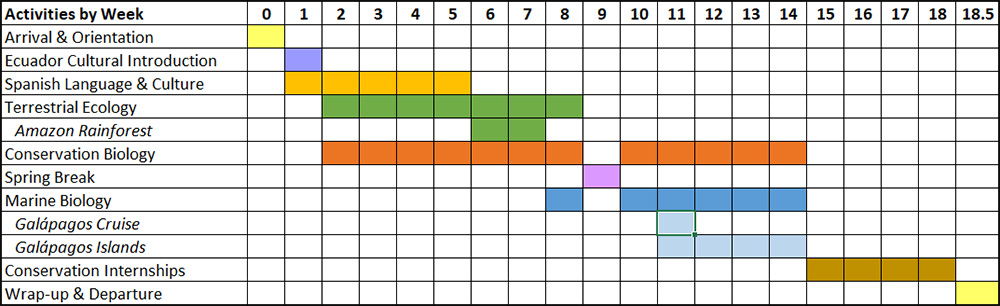
Please note that the schedule below is necessarily tentative, but we will finalize all dates before participants begin booking flights.
Arrive in Ecuador: January 6, 2026 (you’ll be met at the airport by your host family)
Program Orientations: January 8 & 9
Classes Begin: January 12
Classes Conclude: May 20
Depart from Ecuador: May 21
Our study abroad programs are highly competitive, particularly when you consider our extended explorations in remote and incredible locations like the Galapagos Islands and Amazon rainforest. Once in Ecuador, virtually all your expenses are covered, except for lunches while on campus and any weekend activities you care to plan — other than that, it’s all included: in-country housing, meals, campus resources provided by Universidad San Francisco de Quito, the Galapagos cruise (which is about 1/4 of the total cost), and travel to all sites. Here’s a breakdown of the costs:
Ceiba 2026 program tuition: $24,800
University of Wisconsin credit fees: $1,350
CISI Insurance fee (required by UW): $220
Total tuition: $26,370
For many students, the program ends up costing less than a regular semester at UW-Madison. Note that tuition does not include international airfare. We don’t arrange a group flight, preferring to let you decide whether to come early or stay late, to take a bit more time to explore South America!
Thanks to a special agreement with Colorado State University, CSU students can enroll directly through the Ceiba Foundation and our Ecuadorian partner USFQ; contact Ceiba for additional details on application procedures and reduced tuition costs.
Program tuition for students enrolled in TCS will be refunded, less a $1000 cancellation fee, should the student choose to withdraw their enrollment from the program prior to 1 December of the application year. After that date, no refund can be given as most funds will already have been committed to in-country expenses. If the program is cancelled by Ceiba or the University of Wisconsin for any reason prior to that date, tuition will be refunded in full to all participants.
Participants in Ceiba programs are eligible for any financial aid and scholarships offered by the University of Wisconsin or other sources to support your college studies; see the Wisconsin Scholarship Hub (WiSH) for more information, or contact Matt Geisler (matthew.geisler@wisc.edu) and Lindsay Heiser Barger (lindsay.heiser@wisc.edu) at the UW Study Abroad office to explore a wide range of available options.
Ceiba is also excited to offer several Student Ambassador Scholarships, awards of $500 or more based on student needs. The Student Ambassador Scholarship is a needs and merit based scholarship to assist students with the program fees associated with the Tropical Conservation Semester. The scholarship is not deducted directly from the UW program tuition but can be used for additional fees such as required gear, vaccinations and flight ticket purchases.
Applying could not be simpler, just submit online forms to Ceiba and Wisconsin by October 3rd. Need to plan your semester sooner? Ceiba now offers provisional early acceptances to qualified candidates.
Deadline: Apply by Friday, October 3rd (by 4PM) for TCS 2026. To secure your spot sooner, submit your materials at any time and request an early application review!
How To Apply: Applying is a simple two-step process! First, click the Apply button below and fill out Ceiba’s online application form. After that, you will need to go to the University of Wisconsin-Madison program page to fill out their application and upload your transcript.
Program Eligibility: Qualified applicants should (a) have taken one semester of biology or ecology; (b) have a 2.5 cumulative GPA; (c) be able to swim; (d) prior Spanish coursework or experience recommended but not required.
Early Acceptance: You are welcome to request an early review of your application (contact us and send your undergraduate transcript). Ceiba issues provisional early acceptances to strong candidates, which virtually guarantees you a spot in the program as long as you meet UW-Madison eligibility requirements. See the UW Study Abroad program page for more detail.