


Congratulations on your acceptance to the Tropical Conservation Semester in Ecuador! We are excited to have you join this unique learning adventure, and can’t wait to meet you in Quito.
The other materials on the list below may be submitted after the enrollment deadline, but for some (e.g., visa, obtaining a passport) you may need to get started right away. Please read the following list of enrollment steps carefully, and don’t hesitate to holler any questions to courses@ceiba.org.
Ecuador is now requiring students to obtain a visa before entering the country for their study abroad semester. It will be extremely important that students start this process as soon as possible. More information about how to start this process will be emailed to students around the time of the enrollment deadline of October 30th.
 You must have a valid passport to travel to Ecuador, and it must be valid for at least 6 months beyond your travel dates (i.e., your return flight to the USA). If you do not have a passport, apply for one immediately. It can take up to 6 weeks to obtain a passport. Passport applications can be completed at most large US Post Offices or State Department offices (website). If you already have a valid passport, please upload a color scan of the photo page (which must be signed) via the Ceiba enrollment form; otherwise, send it by email to it courses@ceiba.org.
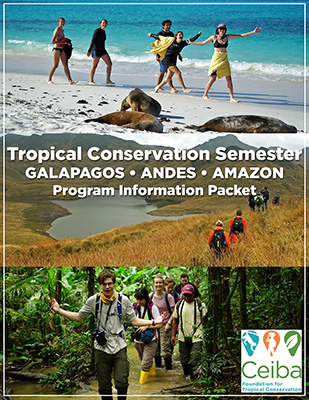 You must read the TCS Program Information Packet prior to traveling to Ecuador. The packet contains important information on the sites we visit, what to bring, course content and activities, required textbooks, and travel details. Pay careful attention to the textbook and packing lists, many of these items are absolutely necessary during the program and can be difficult to obtain in Ecuador.
Please consult the Frequently Asked Questions for the Tropical Conservation Semester. Included are answers to common inquiries about preparation, arrival, and living in Ecuador, health and safety, money, cell phones, diet, and much more. For details about home-stays, see the USFQ Homestay FAQ.
Of course, we are here to help you should you need us! Feel free to contact Ceiba at any time at courses@ceiba.org.
 Download the TCS Liability Release Form and Code of Conduct Form, then email the signed release form to courses@ceiba.org.
Please note that UW Study Abroad also requires students to sign a waiver, a form that can be accessed through your UW MyStudyAbroad account. Their form includes an extra provision allowing you to visit one of Ceiba’s forest conservation sites in coastal Ecuador; for more information about that trip, consult our Health & Safety page.
 We recommend you purchase your ticket to Ecuador early to get the best available fare on the recommended arrival date. Your acceptance and enrollment letter contains details about the recommended arrival and departure dates.
Many flights arrive late at night, or early the following morning (e.g., 2:00 am!) — don’t worry, you will be picked up at the airport as long as you arrive on the recommended date or early the following morning. As soon as you purchase your ticket, please submit your travel itinerary to courses@ceiba.org. Since we use this information to schedule your airport pickup, you must notify Ceiba of any changes to this itinerary prior to your departure. We also recommend you communicate with your host family about your travel arrangements to make sure they will be able to meet you; you will receive contact information for your host family a few weeks after the enrollment deadline. Please see the Frequently Asked Questions for more details on arriving in Ecuador.
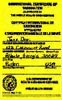 You must obtain a valid yellow fever vaccination to travel to the Tiputini Biodiversity Station in the Amazon Rainforest (the most diverse place on Planet Earth!). You will be asked to present proof of vaccination, typically in the form of a standard “Yellow Book” immunization record, which you should ask your physician to complete when you are vaccinated. Please note that you must sign your vaccination booklet. The vaccination is a simple shot that can be obtained from most health clinics, personal physicians or travel clinics; it is valid 10 days after being administered. Although yellow fever is not a concern at the Tiputini station, proof of vaccination is an inflexible requirement, and no exceptions will be made.
For additional information on travelers’ health, vaccinations, and preventative medications, please consult the Centers for Disease Control (CDC), the UW-Madison Travel Clinic, your university health or travel clinic (if not a UW student), or your personal physician.
 If you are applying through the University of Wisconsin’s Office of International Programs, you will receive a bill from the UW Bursar for the program tuition plus administrative fees; if you are not a UW student you may receive this bill directly from your home institution.
U.S. and Canadian participants should contact the UW Study Abroad Office with any questions on tuition payment (peeradvisor@studyabroad.wisc.edu). Participants from outside the U.S. and Canada should Ceiba for tuition payment instructions at courses@ceiba.org.