

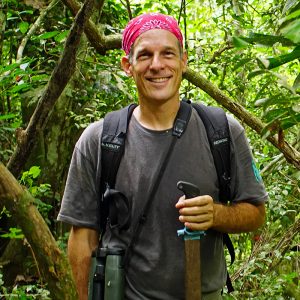
 Dr. Joe Meisel holds a Ph.D. in zoology from the University of Wisconsin and an M.S. in wildlife ecology and conservation from the University of Florida, and is a founding board member and vice-president of the Ceiba Foundation. He has worked in Central and South America for over 25 years, studying the effects of habitat alteration on tropical wildlife. His research interests include the foraging behavior of Neotropical army ants and ant-following birds in forest fragments, the dynamics of wildlife in fragmented landscapes, and GIS modeling of species and diversity distributions. He has led numerous summer and semester field courses in Ecuador, Belize, Panama, and Costa Rica. He has worked in Panama with the Smithsonian Migratory Bird Center, and was the recipient of a Fulbright award for studies of orchid diversity in Colombia. Dr. Meisel is the author of Orchids of Tropical America: An Introduction and Guide (2019), and his newest book is The Marlin’s Fiery Eye and Other Tales from the Extraordinary World of Marine Fishes (2025).
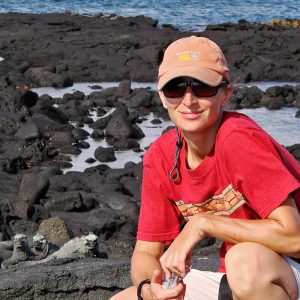 Dr. Catherine Woodward holds a Ph.D. in botany from the University of Wisconsin and an M.S. in tropical botany from University of Florida. She also is a founding board member and current president of the Ceiba Foundation. She has conducted research and traveled extensively in Ecuador and throughout Latin America for over 25 years. For her master’s degree she studied soil disturbance effects on tropical tree seedling growth in reforested areas along the Maxus oil company road in Yasuní National Park, in the Amazonian rainforest of Ecuador. Her current research interests include the impacts of forest fragmentation on plant population genetics and reproduction. Dr. Woodward has worked with the Smithsonian Tropical Research Institute in Panama, conducting field research on birds in forest fragments, and has taught numerous field courses in Costa Rica, Panama and Ecuador. She also is a Faculty Associate leading several courses on tropical ecology and conservation at the University of Wisconsin – Madison.
 Dr. Mauricio Lascano is an Ecuadorian biologist who received his doctorate at Ohio University’s Infectious and Tropical Diseases Institute, with concentrations in Microbiology, Tropical Diseases, and Global Health. He then completed post-doctoral training in the Center for Global Health at the Centers for Disease Control and Prevention. Mauricio’s research interests are focused on various aspects of the biology and epidemiology of tropical infectious diseases. He has explored research topics aimed at generating relevant data that can be used to design and implement adequate disease control and prevention strategies. As an educator, Mauricio has experience teaching a variety of classes, mentoring undergraduate and graduate students, and leading educational trips abroad for students interested in tropical diseases and global health. Since 2022, he has collaborated with the Ceiba Foundation as instructor and course coordinator for the Water for Life program.
 Domenica Gutierrez graduated in Environmental Engineering and Development from EAP Zamorano University in Honduras and went on to complete a Master’s Degree in Conservation and Sustainability Planning at PUCE in Ecuador. Her early experience includes internships at Glen Canyon National Recreation Area and at Ceiba’s Lalo Loor Reserve in Ecuador. She went on to work as a field technician at Ceiba, contributing to initiatives in bio-enterprises, conservation, and environmental education under the “Forest Conservation in the ACUS of Northwestern Manabí” project. She has since become the Project Coordinator at Ceiba and helped conduct internships and volunteer work at the Lalo Loor Reserve, particularly those related to the corridor project. She supervises field staff and oversees Ceiba’s conservation and community development projects, engaging with landowners, communities, local governments, conservation partners and other stakeholders.
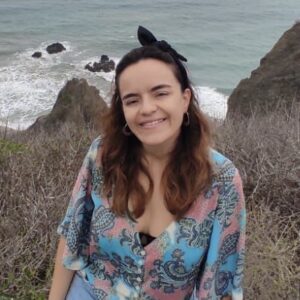 María José Rendón studied Ecology and Management of Natural Resources at Universidad San Francisco de Quito in Ecuador, and earned a master’s degree in Environmental Sciences from the University of Sydney in Australia. She worked as the Director’s Assistant at the Tiputini Biodiversity Station, where she also helped co-manage the station for several months. She has been working with the Ceiba Foundation for nearly five years, coordinating the Tropical Conservation Semester, supervising internships for both local and international students at the reserve, and leading the environmental education program Discovering Ecosystems. She has a deep passion for marine ecosystems, conservation, and environmental education. Her favorite part of the day is seeing participants grow and become leaders in conservation initiatives.
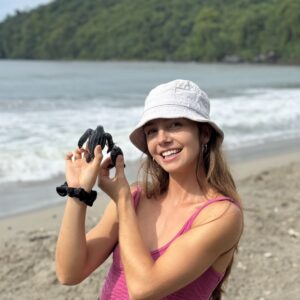 Teal Guetschow, an alumna of Ceiba’s study abroad programs, serves as the marine science instructor for the Coral Reef Ecology course in Belize and for the marine module of the Tropical Conservation Semester in Ecuador. She earned her undergraduate and Master’s degrees from UW-Madison and is now a PhD candidate for a degree in marine biology at Arizona State University. Teal has contributed to a variety of sustainable fisheries and marine conservation projects through her work as a consultant on a global USAID project as well as with the Wildlife Conservation Society Belize. Her current research focuses on leatherback sea turtle bycatch and nesting beach ecology in Trinidad and Tobago. She enjoys mentoring students, engaging them in hands-on fieldwork, and helping them apply classroom knowledge with real-world experiences and conservation challenges.
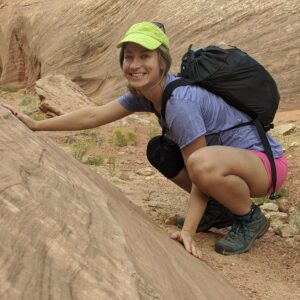 Lilly Pearson earned her B.S. in Geology from Carleton College and later completed an M.S. in Geological Oceanography and Marine Science at the University of Southern Mississippi, where she conducted research in the Coastal Hazards Research Lab. Her graduate work focused on analyzing microfossils preserved in overwash deposits from tsunamis and hurricanes to reconstruct past events and gain insights from modern storms. Science communication has always been central to Lilly’s career, particularly her passion for inspiring others to take climate action. Before joining Ceiba, she worked at NatureBridge, an environmental science education program for youth, where she developed marine and climate-focused curricula and exhibits. Since 2024, Lilly has been part of the Ceiba team, managing study abroad operations and leading engagement efforts in the United States.
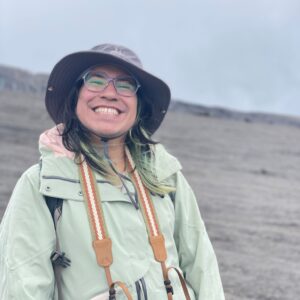 Bas Andrade received a bachelor’s degree in biology at Universidad San Francisco de Quito, where they began focusing on aquatic invertebrate taxonomy and ecology. They have worked on numerous projects in the university’s aquatic ecology lab, one of which resulted in co-authoring the book Los ríos de las cuencas Andino-Amazónicas. They are also passionate about education and have worked with students ranging from elementary school to college in various institutions. Both of these paths led them to their work with TCS and W4L at the Ceiba Foundation, where their skills in teaching and research support the coordination of activities that engage students in active learning about conservation and tropical ecology. Through this work, they have also developed a deeper understanding of the relationships between ecology and society, an insight they strive to integrate into educational activities and future academic pursuits.